89岁,他拿下人生第三个博士学位
2021年9月15日,在美国布朗大学(Brown University)物理系,博士生曼弗雷德·斯坦纳(Manfred Steiner)顺利的通过并获得了博士学位。这一年,斯坦纳已经89岁了,距他开始正式学习物理学已经过去了二十年。
事实上,这已经是过去半个多世纪里,斯坦纳获得的第三个博士学位。
早在1955年,23岁的斯坦纳就已经在维也纳大学(University of Vienna)获得医学博士学位;此后又麻省理工学院(MIT)拿到了一个生物化学博士学位。1985年,斯坦纳被任命为布朗大学医学院血液科主任。
退休以后,68岁的斯坦纳重返校园,从物理学本科课程念起,用整整二十年的时间,取得了博士学位。这位年近九旬的老者说:成为一名物理学家是我儿时的梦想,物理学一直是我生命的一部分。
89岁,他拿下人生第三个博士学位
Brown physics student earns Ph.D. at age 89
By Pete Bilderback, physics program manager
After a 30-year career in medicine, Manfred Steiner returned to the classroom to fulfill a lifelong dream of becoming a physicist.
PROVIDENCE, R.I. [Brown University] — At the age of 89, Manfred Steiner is finally what he always wanted to be: a physicist.
After successfully defending his dissertation this fall, Steiner will receive his Ph.D. from Brown University’s Department of Physics in February. For the Brown graduate student, it is the realization of a lifelong dream — albeit one that was temporarily interrupted by a 30-plus-year career in medicine.
“It’s an old dream that starts in my childhood,” Steiner said. “I always wanted to become a physicist.”
Now that he’s done it, he plans to continue working with his advisor, physics professor Brad Marston, to publish research based on his dissertation, titled “Corrections to the Geometrical Interpretation of Bosonization.”
A winding road

To say that Steiner’s path to a Ph.D. in physics was not a traditional one would be an understatement. As a young man, Steiner fled the chaos of his native Vienna as World War II ended and eventually made his way to the U.S.
“I knew physics was my true passion by the time I graduated high school,” he said. “But after the war, my uncle and my mother advised me to take up medicine because it would be a better choice in these turbulent after-war years.”
Although he excelled at and loved physics, Steiner followed his family’s advice.
“My uncle was a physician — an ear, nose and throat specialist — and he had taught in the United States for a while,” Steiner said. “He taught plastic surgery — showing people how to make noses smaller or how to straighten them out. My family’s advice was that medicine was the best path for me. So I reconciled myself, ‘they are older and wiser,’ and I followed their advice.”
Steiner proceeded to earn an M.D. in 1955 from the University of Vienna and soon after made his way to Washington, D.C., where he finished his initial training in internal medicine. He next began a traineeship in hematology at Tufts University under Dr. William Damashek, who the American Society of Hematology describes as “the preeminent American clinical hematologist of his time.” The traineeship included a three-year training in biology at the Massachusetts Institute of Technology and he earned a Ph.D. in biochemistry there in 1967.
Steiner moved to Rhode Island when he was offered a position as a hematologist in the newly established Program in Medicine at Brown University (now the Warren Alpert Medical School). In 1968, he was appointed an assistant professor of medicine, working primarily in research. He was promoted to full professor in 1978. In 1985 Steiner was appointed head of the hematology section of the medical school, a position he held until 1994.
I could not imagine spending my life playing golf all the time. I wanted to do something that keeps my mind active. But it is a matter of whatever you want to do. If you have a dream, follow it.
Manfred Steiner Physicist
When approaching retirement, an associate of Steiner’s became chief of hematology at the University of North Carolina, Greenville, and asked Steiner to join him to establish a research program in hematology. Steiner went on to direct that program until 2000, when he retired from medicine and returned to Rhode Island.
All the while, Steiner’s passion for physics never left him.
“Even when I was in medical school I went at times to lectures by a renowned physicist Walter Thirring,” Steiner said. “His lectures always fascinated me. I was captivated by quantum physics and wished I could go into more detail in this.”
That deep dive into quantum mechanics would have to wait, however. “You cannot do medicine halfway,” Steiner said. “You really have to dedicate your life to it.”
But throughout his long career in medicine, Steiner says he never stopped thinking about physics.
“Physics was always a part of me,” he said, “and when I retired from medicine and I was approaching age 70, I decided to enter the world of physics.”
The 70-year-old undergrad
Steiner started taking physics classes at MIT, but found the demands of commuting to Boston overwhelming, so he decided to transfer to the program in physics at Brown, where he had spent a good part of his academic life.
He found the Brown physics department a welcoming environment for a late-in-life learner. Teachers were “delighted to have me in class,” Steiner said, and his fellow students liked him and treated him well.

Steiner did not consciously set out to earn a third doctoral degree when he began his studies at Brown. “Originally I just wanted to take classes, doing something that helped my mind and was interesting to me,” Steiner said. But by Spring 2007, Steiner had completed enough classes to be admitted to the Graduate School as a Ph.D. degree candidate.
After admission to the Ph.D. program, Steiner continued his coursework at the graduate level and set out to look for a dissertation adviser. Initially, he considered nuclear physics, but thought it might take him away from his family, so he approached Brad Marston, a condensed matter theorist who also works on climate science. Marston says he did not work on nuclear theory, “so I gave Manfred a project that was the closest to high-energy physics that I did, which was bosonization.”
Marston recalls initially being uncertain when approached by a septuagenarian student about serving as a dissertation advisor. “To be honest, I was skeptical because people do not usually do physics, especially theoretical physics, at an advanced age,” Marston said. “But in a moment of weakness, I agreed and said ‘yes.’ I knew his story, and I was very sympathetic to his desire to fulfill his lifelong dream of becoming a physicist.”
With that, Steiner began working on his dissertation with Marston advising. Throughout the process, Steiner says he made many new friends, especially the faculty who served on his dissertation committee, including professors Jim Valles and Antal Jevicki.
He also tackled a very difficult problem. In the everyday world there are two types of particles: fermions and bosons. Particles have an angular momentum, or “spin.” Particles with half-integer spins are fermions and particles with whole integer spins are bosons. While this might seem like a small difference, it has enormous consequences.
“Electrons are fermions and photons are bosons,” Marston said. “But there are certain circumstances under which you can characterize a fermion as a boson. That is what is known as bosonization, and there are certain advantages to doing that. Usually people do this for one-dimensional problems, but for years I had been working with people like the late Tony Houghton trying to extend this to higher dimensions, such as 2D or 3D metals. We had some success with this, but also discovered some limitations, so I gave Manfred the job of trying to move beyond those limitations. That was a challenging project. I did not give Manfred an easy project.”
Valles says he considers Steiner an inspirational figure.
“I remember meeting Manfred in the hallway when he was taking undergraduate classes,” Valles recalled. “He was unabashed about wanting to do physics and having wanted to do it all his life. His excitement about physics as someone who had such a stellar career in another field felt really affirming.”
Of his dissertation, Valles says Steiner “did an amazing job describing the march of physics in the context of bosonization. He believes in the human mind’s capacity to advance and create knowledge. Seeing him do it was incredibly inspiring, enabling and empowering to me as a physicist.”
The newly minted Ph.D.

Having successfully defended his thesis and completed all requirements for a Ph.D. in physics, Steiner says he’s ecstatic.
“It feels really good,” he said. “I am really on top of the world.” And despite this being his third doctoral degree, it’s particularly special to him. “This Ph.D. is the one that I most cherish because it’s the one that I was striving for my whole life.”
And Steiner is not prepared to rest on his laurels. He is currently reworking part of his dissertation for publication and plans to continue his theoretical physics work.
“Even though I am old, I would like to continue with physics,” he said. “And even after writing and publishing this paper, I want to continue my research.”
That perseverance is consistent with Steiner’s approach to life, and he believes he still has more to offer. “I always tried to keep my brain sharp,” he said. “Physics certainly helped me do that.”
Steiner admits he sometimes wonders how his life might have gone differently if he had not heeded his mother and uncle’s advice as a young man. “I do sometimes wonder how things might have gone differently,” he said. “I do not really regret it now. It was a good life and I made many great friends. It felt very good, particularly after I got my Ph.D. and worked in academic medicine. But physics always lurked in the background.”
When asked what those approaching retirement age should do, Steiner said everybody needs to make their own choices. But for him, the choice was clear.
“I could not imagine spending my life playing golf all the time,” Steiner said. “I wanted to do something that keeps my mind active. But it is a matter of whatever you want to do. If you have a dream, follow it. Sometimes that dream may never have been verbalized, it may be buried in the subconscious. It is important not to waste your older days. There is a lot of brainpower in older people and I think it can be of enormous benefit to younger generations. Older people have experience and many times history repeats itself.”
As for young people choosing between following a passion and taking a more conventional path in life?
“I think young people should follow their dreams whatever they are,” Steiner said. “They will always regret it if they do not follow their dreams.”
https://www.brown.edu/news/2021-11-12/steiner
It’s Never Too Late
Manfred Steiner ’22 PhD pursues a childhood passion.
By Noble Brigham ’24 / September–October 2022
August 30th, 2022
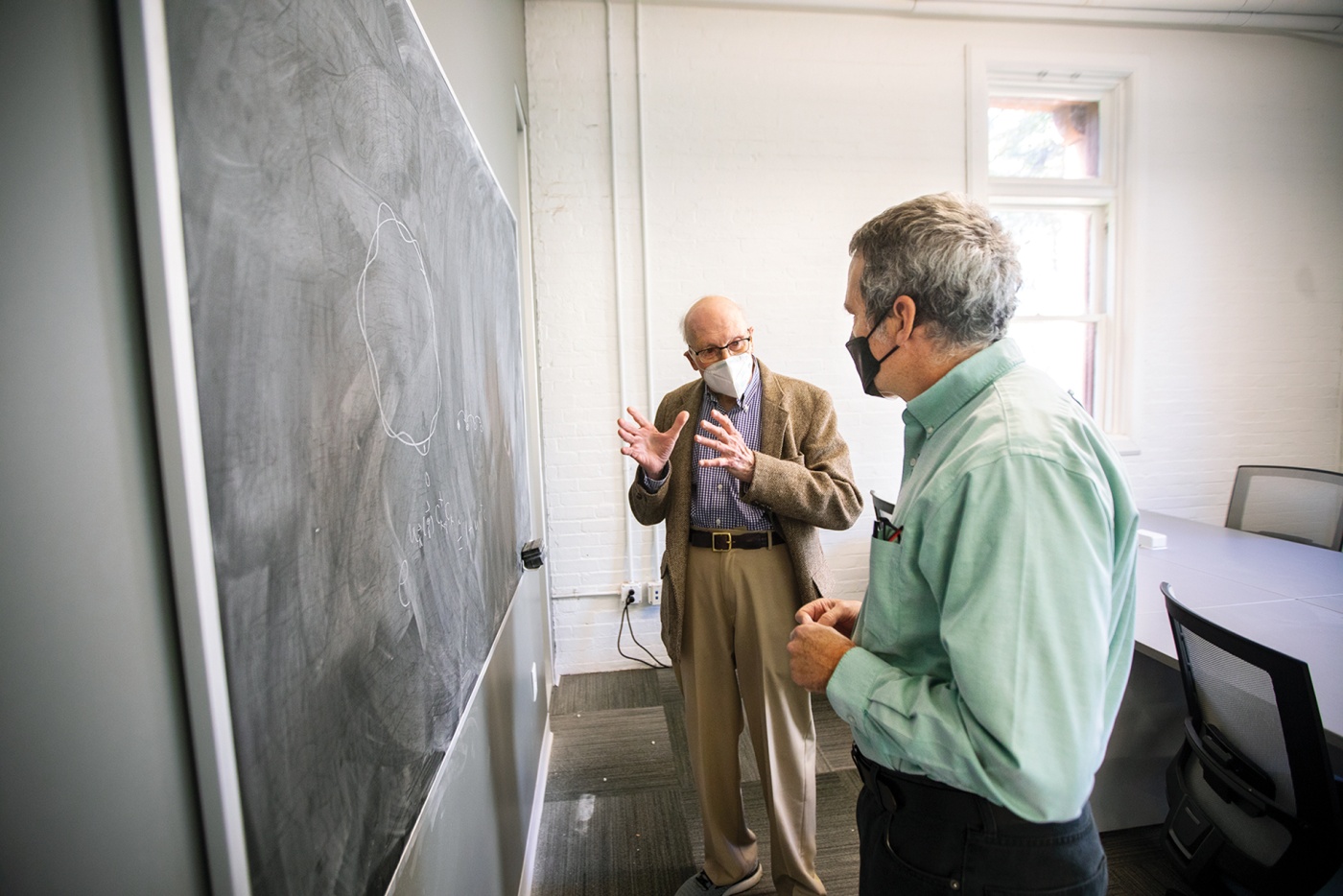
Manfred Steiner, now 90, works on a problem at the Barus and Holley Building with Professor of Physics Brad Marston.Photo: Nick Dentamaro
After emigrating from Austria when he was young, Manfred Steiner–a cheerful, soft-spoken man who is now 90 years old–spent 27 years as a professor at Brown’s medical school, where students used to say that “he speaks like the Terminator” because he never quite lost his accent.
He enjoyed his hematology research and he was good at it. But as a young man, he had wanted to be a physicist, and always, a persistent question remained: “I wonder what would have happened if I had studied physics?” Perhaps he would’ve been a success in that field, too.
When he retired, he decided to find out. Sitting at home without using his mind was “a nightmare,” Steiner says. So he enrolled at Brown as a special student and took one or two classes a semester.
His persistance paid off. In February, Manfred Steiner earned a PhD from Brown’s Department of Physics—more than 70 years after the field first captured his interest.
Steiner describes his childhood as “a terrible time.” Austria—and especially the city of Vienna, where he grew up—was heavily damaged during World War II. Steiner remembers the air raids. And he remembers his father, a university professor and plant pathologist who, unlike many of his colleagues, refused to join the Nazi party. Those who capitulated were allowed to stay home during the war, but Steiner’s father was forced to join the army, Steiner says, as “a punishment.” He did not survive.
In high school, Steiner fell in love with physics. “It fascinated me because of the incredible precision,” he says. No matter how small or enormous something is–from a quark to the universe– “it’s still the same laws and you can prove it.”
Photo: Nick Dentamaro
But his mother and uncle argued that he should become a medical doctor, which his uncle said “would be more secure” than physics. “I followed the advice of my elders,” Steiner says.
Soon after graduating in 1955 with his medical degree from the University of Vienna, he moved to the United States. In contrast to Austria, America was “flourishing” and “progressive,” he says. There was more opportunity.
In his first week, he worked the night shift in the emergency room at Central Emergency Hospital, which was so close to the White House that someone told him he could see into Mamie Eisenhower’s kitchen. Interns like him would go out with the ambulance, and would make the momentous decision of whether or not to take each patient to the hospital.
He became chief resident and trained in hematology at George Washington University. Those hematologists recommended that he go to Boston or Salt Lake City, centers for the discipline. He was accepted at Tufts and started working with William Dameshek, a famous hematologist, chemotherapy pioneer, and fellow immigrant. But Steiner was worried he would have to go back to Austria. Dameshek helped Steiner get a permanent visa “as someone important to the United States.”
In D.C., a fellow doctor introduced his sister, Sheila, to Steiner. A fellow immigrant—her family was from Scotland—Sheila had trained to be an anesthesiologist. She and Steiner married in 1960 and have two children: a daughter who is a medical technician and a son who mediates healthcare mergers.
Jim Valles, a Brown physics professor, says that besides academic pursuits, Steiner’s greatest interests are Sheila and opera—the latter of which Steiner enjoys listening to while drinking single malt scotch.
“When I could realize this dream, it was enormous satisfaction. I did it, finally! So it’s not just for me another degree. It’s really the physics that I love.”
While in Boston, Steiner began studying at MIT and earned a PhD in biochemistry in 1967. Then a friend told him about Brown’s nascent Program in Medicine, where Steiner would go on to rise from assistant professor to full professor to director of hematology.
Word spread in the physics department about the unusual new student who had enrolled. He was 50 years older than most of his fellow students, but he was earnest, “conscientious,” “curious,” and asked good questions, says Valles.
Steiner had started his physics studies at MIT, but the commute was tiring for a man in his seventies. So he switched to Brown, where, after all, he knew the faculty were top notch.
The other students, Steiner says, “accepted me perfectly well.” The professors did, too.
“My brain maybe doesn’t work as fast as the young guys, but I still get eventually to the right answers,” he says, chuckling.
When he had questions, he would go to the graduate students’ office and someone would help him. In his acknowledgements section, he mentions a fellow student who helped him format his thesis.
At first, Steiner didn’t think he would pursue another PhD. But after finishing the graduate school requirements, he says, “I still felt mentally quite competent. And why not go for the cherry, for the big thing?”
His dissertation advisor, Brad Marston, says he “was initially reluctant to take him on.” Most theoretical physicists are young people. But it was clear that Steiner was devoted to his work and that his professional experience had prepared him for scientific research. Plus his story was “compelling.”
So Marston agreed, and helped Steiner pick a topic: bosonization. “I didn’t really have any expectation that he would ever finish,” Marston says. “And he clearly didn’t need a job afterward.”
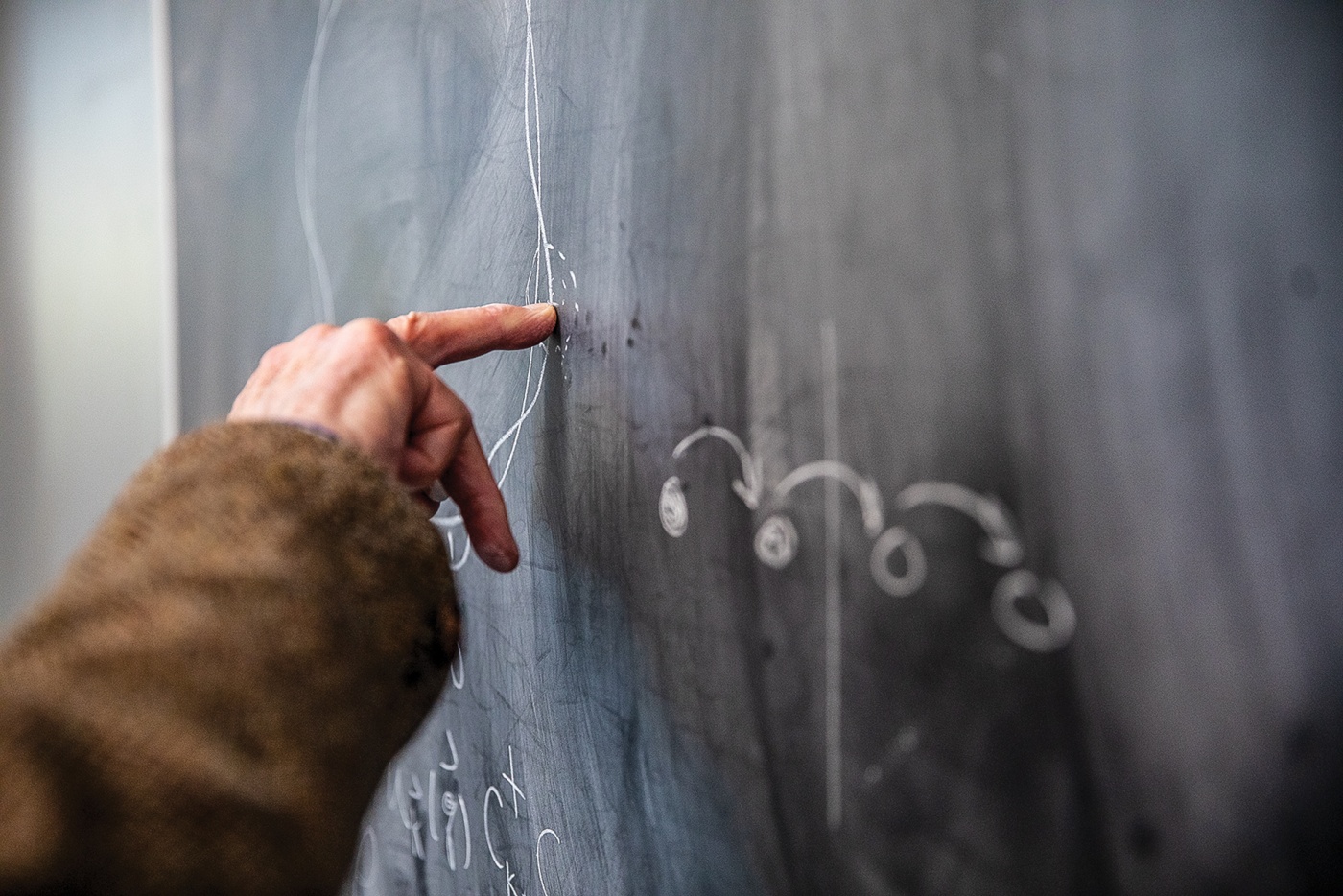
Photo: Nick Dentamaro
Bosonization is in the theoretical realm of physics, which allowed Steiner to stay at home after a long career working in labs. “I never go to the library anymore because everything is online,” he says. His desk in his study at home is covered with stacks of articles from his research and several of the bookshelves are full of physics books.
In September, Steiner successfully defended his thesis, “Corrections to the Geometrical Interpretation of Bosonization.”
“This was always sort of in the subconscious,” he says, “but then, when I could realize this dream, it was enormous satisfaction. I did it, finally! So it’s not just for me another degree. It’s really the physics that I love.”
He’s an inspiration to his professors, too. Valles says, “His making the choice and sticking to it is incredibly affirming to those of us who love physics and have made that choice already.”
Next up for Steiner will be publishing an article that draws from a portion of his dissertation. After that, all he knows is that he wants to stay active. “I’m not looking for a paid job. I know I’m not in the running to be in competition with young people,” he says. “But if they want an older one who can do some research, I would like to be involved in physics in some way.”
Asked if he has considered teaching, Steiner says he’s past that. But he quickly adds that if anyone wants him to be a physics instructor, he’d be happy to help out. He likes students because they are curious—like him. “I like to be challenged by people,” he says. “That’s good. They don’t take everything for gospel truth. They question it.”
Manfred Steiner在89岁获得博士学位、91岁去世的人生经历,其意义可以从多个维度来探讨,这种选择的价值很大程度上取决于个人视角和价值观。以下是一些思考方向:
1. 对个人的意义:终身追求的圆满
-
自我实现:Steiner在退休前是血液学专家,但物理学是他年轻时的梦想。晚年攻读博士对他而言可能是一种对初心的回归,是跨越一生的自我实现。心理学中的"自我决定理论"(Self-Determination Theory)认为,追求内在动机的目标(如兴趣、热爱)能带来深层满足感。对他而言,学术探索本身可能就是意义。
-
时间价值的重定义:许多人认为高龄时努力"为时已晚",但Steiner的例子挑战了这种观念。他的选择暗示:生命的价值不在于剩余时间的长度,而在于如何填充这些时间。91岁去世前,他有两年的时间沉浸在学术成就的喜悦中,这种精神满足可能远超外界的评判。
2. 对社会的意义:打破年龄偏见的象征
-
挑战年龄歧视:现代社会常将衰老与"衰退"挂钩,Steiner的行为直观地证明:认知能力和学习欲望可以持续到生命末期。他的故事成为"终身学习"(Lifelong Learning)的鲜活案例,激励各年龄层的人追求知识。
-
科学精神的体现:他的坚持反映了科学探索的本质——好奇心无关功利或年龄。即便他的研究可能无法颠覆物理学,但这种纯粹的热爱本身已是对学术精神的致敬。
3. 关于"意义"的哲学反思
-
过程 vs 结果:若以"实用性"衡量(如职业晋升、经济回报),高龄读博看似"无意义";但若将意义锚定在体验过程、心智成长上,则完全不同。存在主义哲学强调,意义由个体主动创造,而非外部赋予。
-
文化遗产:他的故事通过媒体报道引发了广泛讨论,成为人类精神韧性的一个注脚。这种精神遗产或许比他论文的具体内容影响更深远。
4. 现实层面的考量
-
健康与代价:Steiner能完成博士研究, likely得益于他此前作为医生的健康管理。高龄学术追求需平衡身体条件,但他的案例证明,在健康允许的情况下,年龄不一定是障碍。
-
对比其他晚年选择:相较于被动接受衰老,他的主动选择可能提升了生命最后阶段的质量。研究显示,有目标感的老年人心理健康水平更高。
结语
Manfred Steiner的选择是否有意义,答案或许藏在他去世前的一次采访中:"当我理解了一个物理概念时,那种快乐就像第一次看到血液循环图一样。" 这种纯粹的智性愉悦,加上对社会的象征性冲击,已构成了一种超越传统成功学定义的意义。他的故事提醒我们:意义的标尺,终究掌握在每个认真活过的人自己手中。